By Team Weltis
One year of Financial Wellbeing as a benefit. What we learned.
Financial wellbeing - 09 April 2026
There's a moment that anyone who works in HR knows well.
A colleague stops by your desk, or messages you on Teams, or waits for you after a call. They have the look of someone who wants to ask something but isn't quite sure how to start. Then they say: "Hey, I wanted to ask you something about my severance fund." Or their pension. Or what happens if they leave. Or a family situation that has nothing to do with work, but that has weighed heavily enough to bring them to you.
You listen. You answer as best you can. You know it's probably not the right answer, or rather, you know it's not enough. But there was nothing else to do in that moment.
This scene has repeated itself thousands of times, in thousands of companies, since employment contracts first existed. And it's nobody's fault. It's the logical consequence of a simple fact that is rarely said out loud: the company is already the main financial provider for every employee. The salary. The severance fund. The pension scheme, if there is one. Tax deductions. Benefits. It is already inside people's economic lives, long before any bank or financial advisor gets there.
Employees know this. And that's why, when they have questions about money, real money, they often turn to HR.
Not because HR is a financial expert. But because HR is the only person in the company who seems to have anything to do with that stuff. And it's precisely for this reason that independent financial planning for employees, the kind with no products to sell, no commissions, and CFP®-certified planners, makes sense starting from the workplace.
The year we understood who chooses financial planning as a company benefit
A year ago we launched Weltis Business with no network in the sector, no structured sales team, and no recognizable brand in the benefits space. With the conviction that someone had to finally equip HR professionals to handle those questions, or better, to no longer have to manage them alone.
What we didn't know was who would respond.
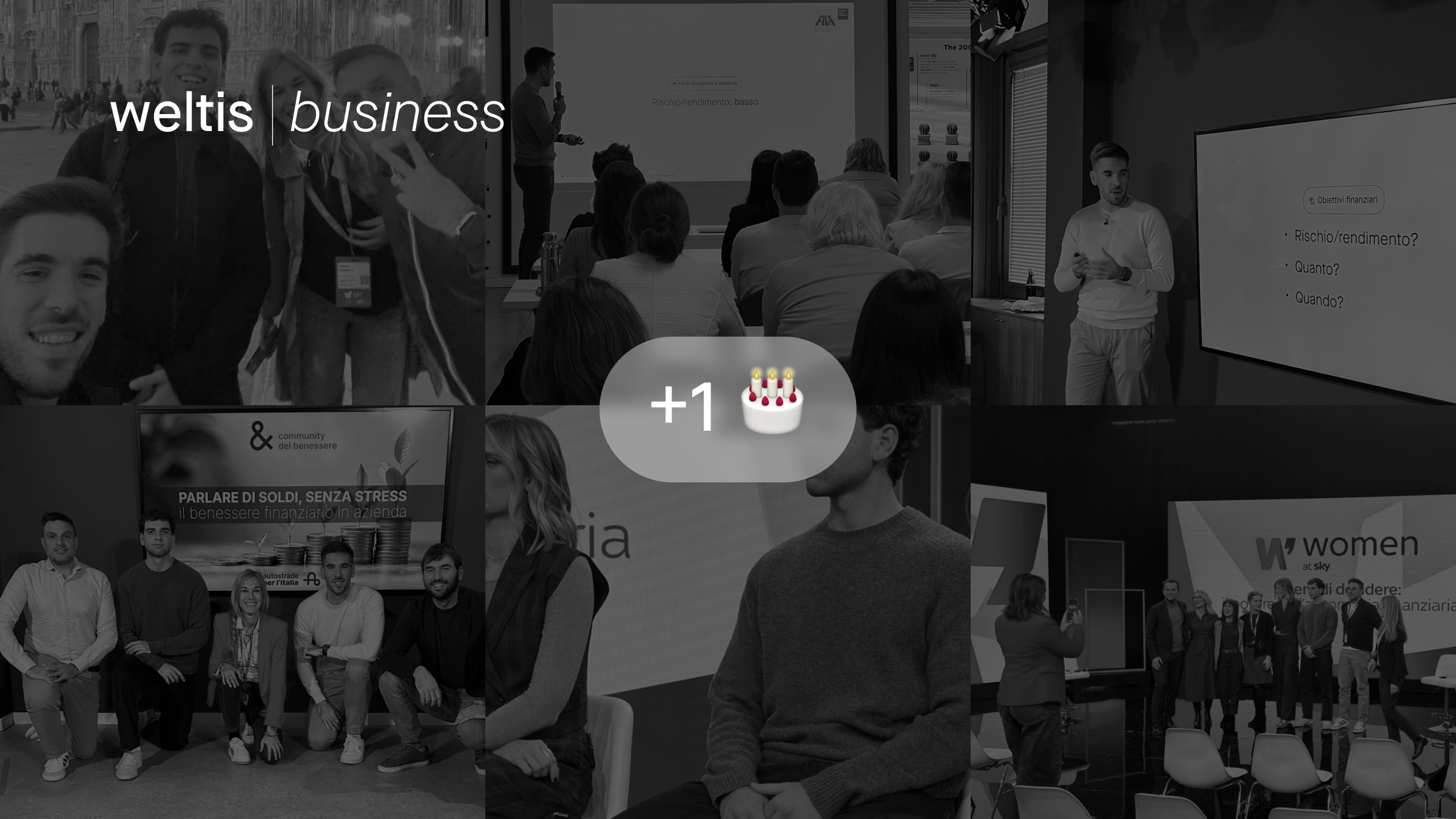
Over the following twelve months we shook hands with very different organizations: Sky, Autostrade per l'Italia, Coop Italia, TheFork, Mindset, Fila Solutions, and many others we'll be announcing soon. Large and small, across distant sectors, with completely different HR structures.
But the people who opened the door to us, inside these organizations, had something in common.
It wasn't the startup early-adopter profile. They weren't looking for innovation for the sake of it. They didn't have a benefits budget to spend and were just looking for something to fill a platform.
They were, almost always, someone who had already felt that weight. Someone who clearly remembered the face of the colleague who had come to them with the wrong question at the wrong time. Someone who had understood, without anyone explaining it to them, that the financial wellbeing of their employees was already an implicit responsibility, even if no job description had ever put it in writing.
Professionals who didn't wake up one morning wanting to add a new benefit. They woke up with the awareness of a real problem and decided to do something about it.
They convinced the C-suite. They found the budgets. They explained something to their colleagues that wasn't yet obvious. They bet on something that hadn't yet proven everything it could do.
What happened in those rooms
Financial planning for employees is not a course and it's not a webinar. It's an individual conversation about an individual situation, with a certified planner who gains nothing from the advice they give.
When Weltis planners sat down with employees at these companies, they didn't find people who wanted a personal finance course.
They found people with concrete situations.
There were those who didn't really understand how their pension fund worked and were about to make a decision that would have pushed their retirement back by three years. Those who had inherited something complicated and didn't know where to start. Those who just wanted a brutally honest opinion on investment decisions they'd already made, without someone trying to sell them something else. Those who struggled to set money aside each month, not for lack of willpower, but for lack of a method. Those who were about to buy a home. Those who had insurance coverage they didn't understand and weren't sure was enough.
Every session was different. None of them were generic.
What they all had in common was finally being a tailored conversation, with no conflicts of interest, no products to sell, no implicit pressure from someone helping you because they're earning something from it.
HR wasn't in that room. But HR had made it possible.
What we learned
Financial planning works in the workplace not because the company is the right place to talk about money. It works because it's already the place where employees bring these questions, and there is finally someone prepared to answer them.
Not HR in place of a competent guide. Not a webinar in place of a conversation. Not content in place of a plan.
We learned that the financial questions employees bring to the workplace are already sophisticated. They don't need basic education: they need someone who can listen to the specific situation and reason through it, without starting from a product catalogue.
We learned that the HR professionals who chose us didn't do it for the benefit itself. They did it because they had already felt the problem and finally had something concrete to offer in response.
And we learned that building trust in this market takes time. A year isn't enough to prove everything. But it's enough to know we're working on the right thing, with the right people.
For those thinking about bringing financial wellbeing to their company
If you're reading this and you recognize that scene, the colleague with the question about the severance fund, the awkwardness of not knowing what to say, the feeling that you're being asked to do something outside your role, you probably already know what we're talking about.
There's no rush. And there's no set format.
If you'd like to understand how it works in practice, we're happy to walk you through it with no commitment. Fifteen minutes. No preparation required on your side.


